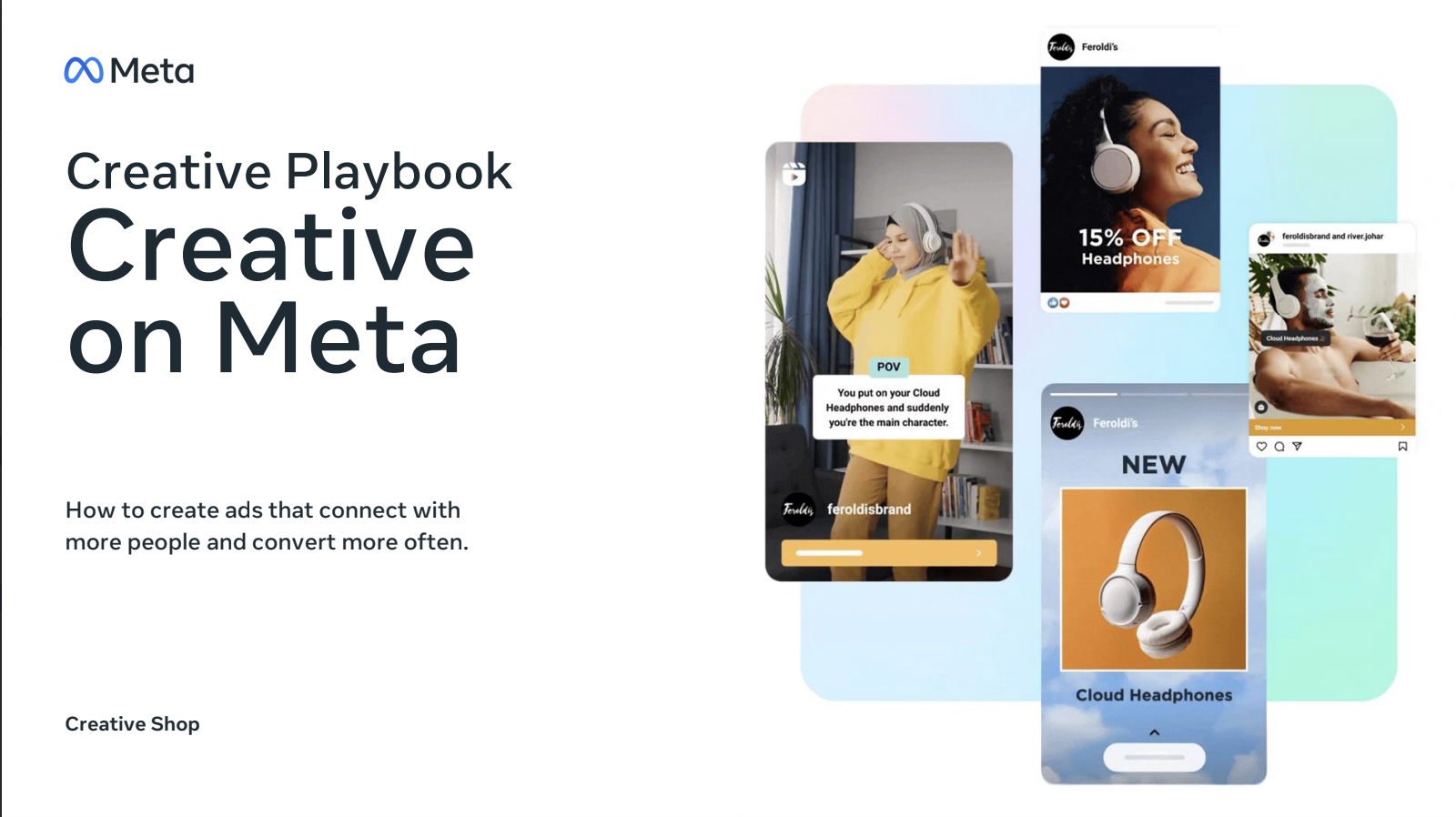
Meta just dropped an updated Creative Playbook and it basically confirms what those of us in accounts every day have been seeing for months: creative IS the targeting now.
With Andromeda, Meta's ad delivery system isn't matching your ads to audiences based on who you told it to target. It's matching based on which creative resonates with which person.
That means if you're running 3 variations of the same static image with different headlines, you're not diversifying. You're whispering the same thing slightly louder.
I've gone through the entire playbook so you don't have to. Here's what matters, what the data says, and what you should be doing differently right now.
Let's start with the hard data straight from Meta's own research, because the numbers are difficult to ignore.
Ad sets that included at least one image (1:1 or 4:5), one video (1:1 or 4:5), AND a 9:16 vertical video with audio saw 9.1% lower CPA than those missing even one of those formats. That's not a marginal improvement. That's the difference between a profitable campaign and one bleeding money.
Ad sets where at least 20% of assets were 9:16 video with audio had 7% lower cost per action. And when those 9:16 video ads were built with audio and within the safe zone, they drove 34.5% lower CPA than static image ads on Reels and 15% lower CPA than non-9:16 video ads without audio.
Layering in even one additional creative element (hooks, text overlays, human presence, audio techniques) drove 13% higher ROAS, 16% lower CPA, 29% higher conversion rate, and 11% higher reach across Reels, Stories, and Feed.
Meanwhile, over 3 billion people connect to Meta's platforms in personalized ways. More than 80% of consumers surveyed prefer brands that offer personalized experiences, and more than 50% spend more with brands that offered personalization. Over 60% of time spent on Facebook and Instagram is now on video, with 4.5 billion Reels shared every day.
The playbook makes it very clear: diverse ad sets enable Meta's ads ecosystem to match the right ad to the right person at the right time. Meta calls this creative diversification.
Creative diversification is Meta's term for the practice of including a range of formats (video and image), visual styles (polished brand-led, lo-fi/UGC, product-focused, creator content), and messaging angles (motivators, barriers, emotional benefits, functional benefits, deals) within each ad set.
This isn't about creating 20 slightly different versions of the same ad. It's about creating meaningfully different creative assets that can resonate with different types of people for different reasons.
The playbook breaks diversification into three dimensions:
Formats: Always create at least three different formats with a mix of video and image assets. Specifically: 9:16 video with audio, 4:5 or 1:1 video, and 1:1 or 4:5 image.
Visuals: Use different creative approaches to maximize differentiation. This includes polished brand-led content, lo-fi or UGC, product-focused shots, creator-crafted content, and animation or illustration.
Messages: Use different messages to augment differences. This covers motivators and barriers, emotional benefits, functional benefits, product use or demos, and deals and sales.
When you combine diversified visuals, diversified messages, AND diversified formats, you give Meta's AI the maximum number of distinct entry points into the auction. That's how you unlock the algorithm's full personalization power.
The playbook makes one thing abundantly clear: video drives outsized value by connecting you with your audiences on the surfaces where they're most engaged.
79% of people surveyed said they'd bought a product or service after watching Reels. Campaigns with catalog product video that delivered to the Reels placement had +33% higher incremental conversions than those that did not.
When creating video for Reels, always start with what Meta calls the creative essentials: build for vertical (9:16), build with audio, and build in the safe zone. Then layer on additional creative elements like hooks, visual dynamism (fast cuts, transitions), audio techniques, text overlays, and human presence.
49% of brand impact across ad campaigns can be attributed to creative quality. Your creative isn't just a vehicle for your message. It IS your competitive advantage.
One of the most valuable frameworks in the playbook is the shift from demographics to motivators.
Demographics are external, broad, "who I am" descriptors (e.g., "27-year-old woman interested in beauty"). Motivators are intrinsic, specific, "how I behave" insights (e.g., "I need evidence as well as peer-reviewed experiences to persuade me to try a new product").
The same product could appeal to different people through entirely different creative treatments: someone motivated by FOMO sees urgency-driven creative, someone motivated by quality sees expert-endorsed content, someone motivated by gifting sees curated gift ideas.
Start with your product features and benefits, dive into comments, reviews, and surveys, leverage your CRM and internal data, ask your community, get emotional about how your product makes people feel, and look for competitive white space you can claim.
Each motivator becomes its own creative concept. Each concept gets multiple hooks. Each hook gets adapted across formats. That's how you build a creative operating system instead of relying on one-off hero ads.
This is probably the biggest mindset shift the playbook advocates for, and it's one I see too few businesses actually executing.
The old approach: create one "hero ad," target it at a predefined audience based on demographic data, and hope for the best.
The new approach: one product or service flows into multiple concepts (each based on a different motivator), each concept gets remixed with different hooks and messages, each remix gets adapted across formats (9:16 video, 4:5 video, static image), and then you let Advantage+ creative layer on automated personalization at the impression level.
That's how you go from one asset to dozens of meaningfully different ones, and that's how you give the algorithm enough signal diversity to actually find your buyers at scale.
Volume matters, but volume is most meaningful if the assets are meaningfully different. The playbook offers several practical strategies for scaling creative output:
Lean into hooks: A hook is the first couple of seconds of a video where we decide whether to keep watching or keep scrolling. Hooks that resonate sound like a text from a friend, a truth they didn't want to say out loud but finally are, a quiet confession, or like it came from the comment section. Film multiple hooks for each video based on distinct motivators.
Remix existing creative: Identify different sections of your video with visual impact and bring them up front to create new remixed Reels from existing footage.
Iterate on winners: Identify your top performing assets, break down their components (videography style, frame device, customer review overlay, the product itself), then experiment with switching out just one variable at a time to create new assets.
Turn images into video and video into image: Use templates, video backgrounds, and AI enhancements to turn static images into engaging video. Pull key frames from your videos to create scroll-stopping image ads.
Shoot in 9:16 first: Then adapt your aspect ratio for other video formats and pull stills for image ads. This is the most production-efficient approach.
Meta's Advantage+ creative features represent the final layer of the system. These generative AI tools allow you to amplify creative volume and personalization at the impression level:
Add animation: Transform static images into engaging animated videos with text overlays and music. Nearly 2 million advertisers are now using video generation tools.
Video generation: Transform multiple images into dynamic multi-scene videos (currently in beta).
Text and translation features: Automatically produce multiple captions, translate captions and voiceovers into your customers' preferred language, and reach new audiences without changing your creative.
Image generation and enhancement: Generate up to 10 new image assets inspired by your existing creative, improve brightness or contrast, expand images to fit placements, and diversify background imagery.
When more than 90% of assets leveraged AI-enabled video generation in beta testing, Meta observed 10% higher CTR and 7.7% higher CVR versus assets that did not use the product.
The businesses I see struggling right now are the ones still building one "hero ad" and wondering why performance tanks after week two. That's not a media buying problem. That's a creative volume and diversity problem.
If you're running Meta ads in 2026 and you don't have a creative operating system, you don't have a strategy.
Every stat I've referenced in this article comes straight from Meta's data in their updated Creative Playbook. You can download the full PDF here and dig into the details yourself.
Most businesses are running the same creative approach they used two years ago and wondering why costs are climbing while results are shrinking. The platform has fundamentally changed. What used to work at $5K/month in ad spend breaks at $30K.
We've managed over $30M in ad spend and driven more than $125M in revenue. We know what's converting right now, what the algorithms are rewarding this quarter, and where most businesses are bleeding margin without realizing it.
Book a free strategy call with SXV Digital. We'll break down your current setup, show you exactly where money is being left on the table, and map out what a profitable scaling roadmap looks like for your business over the next 90 days.
Disclaimer: The data, statistics, and research findings referenced in this article are sourced from Meta's official "Creative on Meta: Creative Playbook" published by Meta's Creative Shop. This content is a summary and commentary on Meta's published materials and is not created by, endorsed by, or affiliated with Meta Platforms, Inc. All trademarks, including Meta, Facebook, Instagram, Reels, Advantage+, and Andromeda, are the property of Meta Platforms, Inc. The original playbook and its contents are the intellectual property of Meta. SXV Digital shares this information for educational purposes to help advertisers improve their Meta advertising performance. For the most current and authoritative guidance, please refer to Meta's official resources directly.